
Another "mental health" failure
And another ancient Greek success

Dear T,
The New York Times reports that paying too much attention to your mental health is bad for your mental health — something we knew, and have known, and have had in writing, since people were sacrificing goats to Pallas.
They say, in an article titled, Are We Talking Too Much About Mental Health?
Students who underwent training in the basics of mindfulness, cognitive behavioral therapy and dialectical behavior therapy did not emerge healthier than peers who did not participate, and some were worse off, at least for a while. And new research from the United States shows that among young people, “self-labeling” as having depression or anxiety is associated with poor coping skills, like avoidance or rumination.
The University of Oxford went further, and said that awareness campaigns, so far from reducing pain, were adding to it. They said that people who experienced sadness and worry were then focused on how sad and worried they were; and instead of, say, accepting them as a part of life or finding meaningful solutions, they were labeling them horrible things and then blowing them out of proportion. Oxford researchers then labeled this explosion of false and reckless self-diagnosing “prevalence inflation” — the clinical term for "being a whiny bitch.”
There are other ways of going about life, of course. Try comparing the “scientific” approach to mental health with a pagan one, for instance, which was thought up well before anybody knew about serotonin. Seneca sums a happy life up in a few easily-digestible categories:
[I]t comes from having a good conscience, from taking honorable counsel, from doing the right thing, from looking down on fortune, from a calm and steady mode of life that walks along a single road.
In other words, instead of chasing good things, he recommends being them — a shift from empty consumer to producer*. But even this is too abstract for many. A little more down-to-earth, Diogenes Laertius writes of the philosophy of Chion (Mensch translation),
When asked in what respect the educated differed from the uneducated, he said, ‘In good hopes.’ When asked what is hard, he said, ‘To keep a secret, to use leisure well, and to be able to bear an injury.’ He offered the following advice: Watch your tongue, especially at a drinking party. Do not speak ill of your neighbors; for if you do you will be spoken of in ways that give you pain. […] Be quicker to visit friends in adversity than in prosperity. [...] Honor old age. Take thought for your safety. Prefer a loss to an ill-gotten gain; the one will only grieve you once, the other forever. Do not laugh at another’s misfortune. When strong be gentle, that you may be respected, rather than feared, by your neighbors. Learn how to manage your own house well. Do not let your tongue outrun your thought.
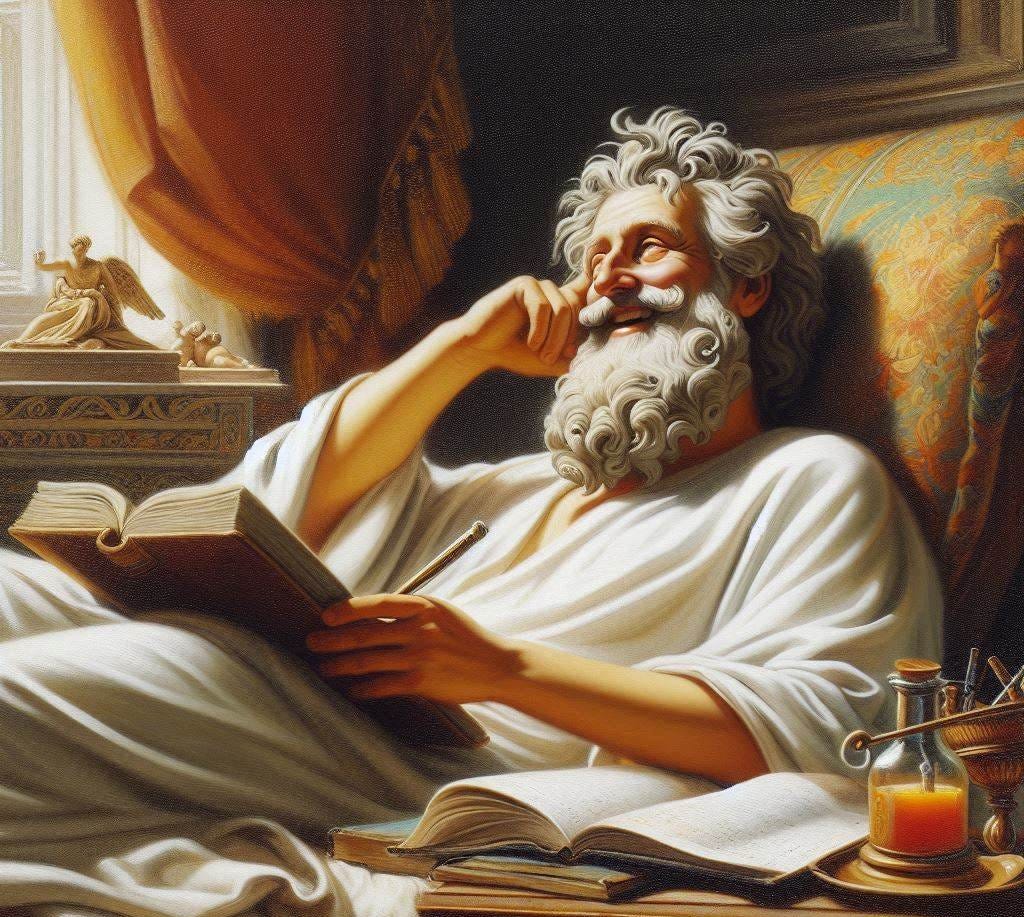
What you see here is a series of beautiful things, which you can easily observe, dream about, and sometimes be. Each of them is concrete, shareable, and free to anyone who wants in.
The modern man, by contrast, despite having a reputation for being skeptical and materialistic, is a believer in fairy tales and snake-oil spirituality. He first of all proposes happiness as a goal — an abstract, nebulous, and slippery concept that tends to disappear the harder you focus on it. And then, in order to attain this impossible state of nirvana, he proposes you get rid of concrete negatives, such as sadness and worry. A crazy, childish, and impossible philosophy.
Yours,
-J
P.S. They won’t admit it outright, but the other solution for misery, in the eyes of modern men, is to try and drown out personal failures with "big issues” — like taking your mind off a headache by crushing your finger with a hammer. Not a wise solution, but a very effective one. Once you've decided God is irrelevant and you either can't or won't fix yourself, politics and moral crusading are the only antidotes you've got left.
Walter Hooper says that when CS Lewis dropped The Screwtape Letters in 1942 he was accused by some loudmouths of being trivial, and even petty — like a moron might take Chion’s domestic advice above. Thus Hugh Graham wrote for the Times in 1966, With the concentration camps across the Channel and the blitz at home, Screwtape seems to have been aiming at rather small targets and to have been decidedly lacking in the historical imagination.
W.W. Robson wrote in the Cambridge Quarterly, about the “general moral pettiness” of The Screwtape Letters, that in an age which has produced Auschwitz, it is distasteful to have such slight topics associated with human damnation.
But it’s almost always the slight topics that damn us. The big fights are cataclysmic and dramatic — and temporary. The little domestic horrors are forever. We forget that what the big wars and the ideological clashes and the crusades are about is home**; and if you look closely, you’ll find too many of the crusaders’ souls are in shambles. They forgot how to answer gently. They forgot to forgive quickly. And they forgot to admit when they're wrong. And because they forgot the little things, they made the big things all pointless.
*There's a major flaw with the sanctification of “mindfulness,” and it’s that an extreme focus on what exists right now can only help if your “right now” isn't a disaster. As Beth Dutton put it, I think heaven’s right here. So’s hell. One person can be walking the clouds right next to someone enduring eternal damnation. Part of this is physical. Most of it is relational and spiritual.
As such I believe in practicing mindfulness. There's a point where you just have to stop and smell the flowers. But mindfulness by itself, as a cure-all panacea to spiritual ills, is actually more a negative than a positive. A man who's in love or connecting with God will keep what he has for as long as he can. A man who's in love with mindfulness, most usually, is reaching wildly for a shutoff switch. And you can’t just turn off being a failure, or a fool.
**Speaking of having a good home, Nietzsche says, “He who has a why to live for can bear with almost any how.” And Viktor Frankl adds, of those who survived the Nazi concentration camps,
[I]t did not really matter what we expected from life, but rather what life expected from us. We needed to stop asking about the meaning of life, and instead to think of ourselves as those who were being questioned by life—daily and hourly. Our answer must consist, not in talk and meditation, but in right action and in right conduct. Life ultimately means taking the responsibility to find the right answer to its problems and to fulfill the tasks which it constantly sets for each individual.
These tasks, and therefore the meaning of life, differ from man to man, and from moment to moment. Thus it is impossible to define the meaning of life in a general way. Questions about the meaning of life can never be answered by sweeping statements. “Life” does not mean something vague, but something very real and concrete, just as life’s tasks are also very real and concrete. They form man’s destiny, which is different and unique for each individual. No man and no destiny can be compared with any other man or any other destiny. No situation repeats itself, and each situation calls for a different response.
[…]When the impossibility of replacing a person is realized, it allows the responsibility which a man has for his existence and its continuance to appear in all its magnitude. A man who becomes conscious of the responsibility he bears toward a human being who affectionately waits for him, or to an unfinished work, will never be able to throw away his life. He knows the “why” for his existence, and will be able to bear almost any “how.”
***There’s a reason why people say being a grandparent is even better than being a parent. A grandparent, due not just to experience, but to the reduction of play-time to short bursts, can be to some children what he could never be to his own: that is, a pure joy. A grandparent first and foremost is an actor — and he revels in his own performance.