
Sex at Dawn: a counterpoint
Or, why man doesn't mate like a monkey

Dear T,
I read Christopher Ryan's Sex at Dawn because I'm a horndog, and like all horndogs I need an excuse for my existence. His short and brutal book, an evolutionary survey of human sexuality, a work which gives no solutions (he says so himself), and levels us with the apes, is good at describing the problem of sex; and if it doesn't give any solid guidance, it at least helps us to not feel like freaks.
Which I felt like until I was about 30, because I was raised in a strict Evangelical household. And my house was strict because my mom was born out of wedlock in Tegucigalpa.
Her dad married someone other than her mom, and my mom spent her childhood hiding in closets from her father's wife*, Thus her view of sexuality was strong — she knew it could traumatize kids and wreck your life, and it had to be controlled at great cost. So sexual expression wasn't really approved in our household, because if she had any say in it, what happened to her was never going to happen to us, or hopefully to any of her grandkids.
It was said that sex was for marriage and left at that. Talks about sex were semi-formal and awkward and disturbing — and delivered too late. If sex was mentioned on tv it was countered with groans of disapproval. I was told women don't like sexual attention**, nobody told me about masturbation or ejaculation until well after I'd crossed all the lines, and if a woman was dressed provocatively, the overall rule was eyes to the floor. It was always no and Jesus is watching — not just where your hands and your eyes went, but where your mind did.
This put me into a state fluctuating constantly between ecstasy and shame and terror. I was always thinking about naked women, and the thought that one day I'd get discovered was hanging over me like a death sentence. So when a man like Christopher Ryan tells me I'm not a deranged man, but a high-standing ape, I listen. Perspective is everything when you're looking for a pardon. Did you get kicked out of heaven — and deserve to be shamed? Or are you climbing out of the mud — and deserve to be pitied?
Ryan believes it's the latter, and that if we came from the apes, the climb up to chastity is a bitch. He has plenty of arguments and data to back it, such as
That we're genetically most like chimps and bonobos, and that bonobos are the horniest, skankiest animals on the planet.
That gibbons are the only truly monogamous apes, and all the rest of them are “deviants.”
That almost all other animals are horndogs only during menstruation — except for humans, who are horny all the time. And,
That fertility is a side-issue for us, unlike the rest of the animal kingdom.
He says, with disturbing clarity,
The animal world is full of species that have sex only during widely spaced intervals when the female is ovulating. Only two species can do it week in and week out for nonreproductive reasons: one human, the other very humanlike. Sex for pleasure with various partners is therefore more “human” than animal. Strictly reproductive, once-in-a-blue-moon sex is more “animal” than human. In other words, an excessively horny monkey is acting “human,” while a man or woman uninterested in sex more than once or twice a year would be, strictly speaking, "acting like an animal."
In addition to these points, he calls to witness the advertisements claiming to spice up old marriages, the ugly success of the porn industry, and — as if these aren't enough — he asks us to take a frank look at the things we dream about, plan for, and look back fondly upon***. (He also cites archaeological digs and studies of bushmen****, but I think to little effect. The bones tell us nothing about romance, and the bushmen are outliers and failures).
All this evidence leads him to wonder why, exactly, we took up monogamy so globally. Like the average Marxist, he blames it on the Agricultural Revolution. Once we had property, sexual paradise was over. Then you weren't just sharing your kill: you were hoarding your crops — a way more arduous job in general. When you were hoarding your food, and every ounce of it was worked out of the ground by skill, and sweat, and by luck, you couldn’t just share it with anybody.
Other men's children took a backseat to your own. If some were your children then so were the women you made them with. One or more women, if you could afford it (the more the merrier, for a while); and the more prosperous you were, the more women traded sexual exclusivity for security. Thus sex, for a woman, was just as much for profit as for romance. What was once an all-you-can-eat buffet, a la the Garden of Eden, became a closely-guarded hen house.
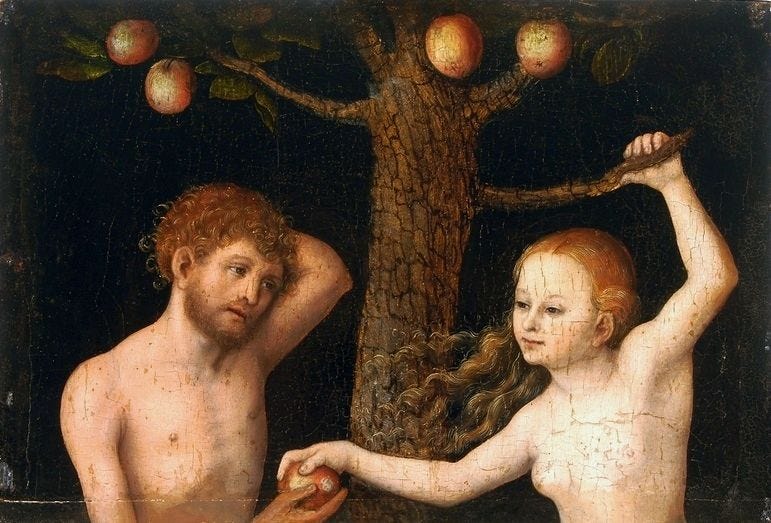
This at least is what Ryan thinks. But what's surprising is he thinks we can go back. As if jealousy is something we invented, or that pillow-talk promises are merely business. Are sharing goods in common and sharing women in common the same thing? And if we get rid of a barn, are we really going back to The Garden?
But even if (as Marxists believe) getting rid of property means embracing promiscuity*****, the bridge was burned before any of us could vote on it. Once the population exploded we became slaves to the fields. Every advance we ever made was a trap in the same vein. We flew to the moon and got chained to our desks. Property meant a new way of thinking, of planning, of loving. What may have been monkey business at one point became serious business — to the point where a whole society armed itself against the promiscuous, and the societies that didn't were left behind, from yesterday's bushmen to today's ghetto.
Even polygamy lost out to monogamy. The men who had too many wives couldn't keep up with them. The men who had no wives caused trouble for everyone else. The monogamists bred their children faster, raised their children better, kept the men in line better. Society was more stable, and what was once a fringe element, even to the Chosen People, ended up a world standard. The equal distribution of goods was a bust******, but the equal distribution of women was the only thing that worked.
Some people say that promiscuity and polyamory are disgusting. But Ryan says tastes vary between cultures ("an islander had sex with an 11 year-old in public!"), and that if some African hillbilly can drink saliva beer, maybe we can do gang-bangs too. And what about the apes? Isn't it possible that if we left their ways behind, we could pick them up again?
To this question I ask, which ape's ways? Promiscuity like the bonobo? Or gang-bangs like the chimpanzees? How about we do it like the gorillas or the orangutans — polygamy, or rape? And if the apes are different from each other, couldn't we, the most unique of the apes, be different from them? Couldn't the species that loves Romeo and Juliet have its own brand of sexuality — one that's way more robust, fantastical, romantic, nuanced, embarrassing, surprising, hilarious, guilt-ridden, exhilarating, perverted, regrettable at times; making most of us vulnerable and anxious; overpromised and underdelivered; underpromised and overdelivered; building and wrecking reputations; everyone a dreamer and a luster but some of us turned professional? And wouldn't this make us completely unique? That is, a species with our own laws, and customs, and manners, and art-forms? And couldn't those of us who do it ape-style be worse off — financially, emotionally, spiritually, and relationally — even if we have the gonads for it?
I agree we share a lot with the apes, and that one of these things is an insatiable drive for “free” sex. But one thing we don't share with apes is our foresight — and once we got these brains, whether from God or from Mother Nature, we applied them to relationships. So Mr. Ryan is expressing his birthright as a human being here: to see what's being done and imagine it another way — the foundation of all progress and, in an age of science, of almost every human catastrophe. But there's a difference between imagining the possibilities and calling them all equal; and if Ryan thinks he can change romance by bringing up the apes, who knows? Maybe he'll end up hiding kids in the closet from his new wife. And if the kids have any brains, maybe they'll see dad acting like a bonobo, and decide instead to ape great grandpa — probably a Catholic, or an uptight Evangelical.
Yours,
-J
P.S. The thing that irks me about this book is the way it was framed. It could have been a paean to chastity — a deep look at the enormous difficulty (and let's not forget the payout) of being true to someone and loving them until they die. But the difference between leftists and conservatives is starker here than ever. A conservative would look at this book and then admire the man who has ten kids, provides for them, raises them well, and is loved by his wife. Otherwise what we know as the human, almost god-like talent for family values. But the leftist doesn't look up to the patriarch — the master of his urges and the establisher of dynasties. The liberal looks back to the bonobo — not to show how far we've come and how majestic we can be, but to justify the deadbeats and the baby-daddies.
Ryan's take is discouraging, but I don't mean to trash the whole book. He leaves us some real gems, such as this piece on sociability:
Sartre got it backwards when he proclaimed, “L’enfer, c’est les autres” (Hell is other people). It’s the absence of other people that is hellish for our species. Human beings are so desperate for social contact that prisoners almost universally choose the company of murderous lunatics over extended isolation. “I would rather have had the worst companion than no companion at all,” said journalist Terry Anderson, recalling his seven-year ordeal as a hostage in Lebanon
and this musing on civilization:
making sense of human nature is anything but simple. Human nature has been landscaped, replanted, weeded, fertilized, fenced off, seeded, and irrigated as intensively as any garden or seaside golf course. Human beings have been under cultivation longer than we’ve been cultivating anything else. Our cultures domesticate us for obscure purposes, nurturing and encouraging certain aspects of our behavior and tendencies while seeking to eliminate those that might be disruptive. Agriculture, one might say, has involved the domestication of the human being as much as of any plant or other animal.
and this well-buried nugget of Mark Twain's,
[Man] has imagined a heaven, and has left entirely out of it the supremest of all his delights, the one ecstasy that stands first and foremost in the heart of every individual of his race…sexual intercourse! It is as if a lost and perishing person in a roasting desert should be told by a rescuer he might choose and have all longed-for things but one, and he should elect to leave out water!
*I never met my grandpa Enrique but I love him. He's actually a big deal to the whole family. He was so smart and useful that the Honduran government hired him as a civil engineer, and you can see his bridges and highways all over the country. He worked hard and saved up and reinvested into the family — sending all his siblings to college, and thus saving them from third-world poverty. I'm fuzzy on the numbers, but from what I can gather he sent between six and ten people altogether. A feat that qualifies him for sainthood in any country.
He had a sense of humor so sharp that it became a defining characteristic — a sense of humor I inherited, I'm told, and for which my grandma, his ex-girlfriend, calls both of us el terriblé. He was so charming that women couldn't keep their skirts on, which I also inherited. The difference is, whether out of timidity or cowardice or Jesus Christ, I learned to control myself and he didn't.
He tried to marry my grandma after my mom was born and grandma refused for some reason or another. But my mom was born to him anyway and he married somebody else; and if my grandma wasn't married into his new family, my mom was unofficially. And when my mom would visit him, his new wife came around and my mom was told to hide in the closet. Thus she always felt unwanted, and illegitimate — something to be covered up and hidden away. He broke her heart and she carried it with her the rest of her life.
I never met grandpa Enrique because I never had the chance to. Mom was adopted, effectively, by other members of his family — beautiful people, hard-working people, middle-class and solid Catholics — and she was taken out of Tegucigalpa to be raised in the San Francisco bay area. She always wondered if he loved her, but was so badly burned that she never really talked about him******. And she didn't want us to get burned like she was. I never got a call from him, or a letter, or, so far as I'm aware, even a mention. She stayed away from him and she made sure I did. Out of sight, out of mind.
But one day she had a stable, loving family of her own; and she decided that what happened ought to be put behind her, and that maybe it was time to reconcile. She made the trip back to Honduras and saw him for the first time in decades — and he was so charming, so friendly, so familiar, that she said it felt like they had been together the whole time.
He told her he had a surprise for her. This eighty-plus year-old man then introduced her to her new sister, a baby, when he was over 80 years old and his actual wife was well past menopause. Mom then realized he was the same he'd always been, that he was still ruining women's and children's lives, and she left him behind, never to see him again. He passed away shortly thereafter. I want to meet him and I'll never get the chance to.
**I know women like sexual attention because I've met too many of them. But some evidence does favor my mom's theory that they “don’t”.
One interesting study mentioned by Mr. Ryan (Clark and Hatfield, 1989 — look it up) involved students at Florida State University. These researchers got a hot girl and a hot guy to go around asking people for a roll in the hay. When the men were approached by the hot girl, 75% of them said yes, and if they couldn't say yes, they almost always asked for a rain-check. But when the hot guy approached the women, zero said yes — a result researchers continue to get on many campuses since.
This doesn't prove women hate sex. But it does mean they have brains, and that if you want to turn them on, you've got to have either talent or booze.
***A lot can be said about remembering past lovers, but an ugly fact stands: according to even The Atlantic, the fewer sexual partners you have, the happier your marriage is likely to be. By some miracle I did okay, but most skanks and players don't. In the long run, the prude almost always has the last laugh.
****Ryan writes regarding the Matis people,
Anthropologist Philippe Erikson confirms, 'Plural paternity…is more than a theoretical possibility…. Extramarital sex is not only widely practiced and usually tolerated, in many respects, it also appears mandatory. Married or not, one has a moral duty to respond to the sexual advances of opposite-sex cross-cousins (real or classificatory), under pains of being labeled ‘stingy of one’s genitals,’ a breach of Matis ethics far more serious than plain infidelity. ”Being labeled a sexual cheapskate is no laughing matter, apparently. Erikson writes of one young man who cowered in the anthropologist’s hut for hours, hiding from his horny cousin, whose advances he couldn’t legitimately reject if she tracked him down.
This hilarious example aside, one thing that's missing in the "monogamy is just a matter of taste" argument is that other forms of sexuality go way beyond comedy and "tastelessness." I mention here such abominations as pederasty, incest, bestiality, kidnapping women and forcing them to marry you, war as a means of acquiring sex slaves, and giving somebody a Dirty Sanchez — each of which I think deserves a giant scowl and a lamp-post to match it.
Ryan, like the cosmopolitan and the sociologist, argues from a broad perspective. He takes humanity as a whole and forgets how to be somebody in particular. But to be offended by nobody is to be disgusting to everybody. The fastest way to become disgusting is to argue that nothing is.
*****Some evidence that property necessitates monogamy is Winston Churchill's mom -- a woman reputed in The Last Lion to have over 200 lovers; and whose lovers, on almost every continent, and in every place of privilege, opened the whole world to her son. We might even owe winning World War 2 to it. If she'd been a poor black woman in Newark she would have been labeled a ho, or died of disease, and Winston would have ended up mired in crime and poverty and disgrace. But somehow Jennie Churchill had a great time and got “further in life” because of it. Money seems to be the answer here — that and land and a title.
The Victorians come across as prudish to us, but the fact here is that being uptight was mostly for the middle and lower classes. To be nobility in Victorian England was to be a lover of nobility; and massive parties were arranged, in mansions with dozens or hundreds of rooms, where extra-marital affairs were planned by the hostess in advance.
A good planner got a reputation by knowing whose room to put next to whose. When the lights would go dim, ladies and gentlemen would scurry out of their beds and into another's; and before the sun came up, before anyone could see any faces too well, a servant would ring a bell, and husbands and wives would slip quietly back to their rooms.
Today we excuse fooling around before marriage, and if you cheat on your wife you're a jackass. The Victorian nobility believed almost the opposite. You were chaste until marriage and then you could (discreetly) act single. Jennie Churchill cheated on Randolph until the day he died. He got syphillis from a random prank encounter with a prostitute, went insane, and from the moment they found out about it, he never made love to Jennie again.
The big question is, were they ever really happy? And how did Winston feel about it?
He adored her and never got her attention. He never really chased women, had sex rarely, and by the time he was a big name in politics, was completely impotent. Like with my mom, one extreme begets another. Monogamy begins with the suffering from promiscuity. You can throw the rules aside for a while, but someone, maybe your child, maybe your grandchild, will pick them right back up again — and turn you into a horror story.
******Cleon Skousen writes, in The Naked Communist, of the Marxist view of problem-solving,
[The Communist's doctrine is] that problems can be solved by eliminating the institution from which the problems emanate. Even Marx and Engels may have been unaware that this was what they were doing, but the student will note how completely this approach dominates every problem they undertook to solve.
Take, for example, the problems of government. Marx and Engels would solve these problems by working for the day when they could eliminate government. Problems of morals would be solved by doing away with morals. Problems growing out of religion would be solved by doing away with religion. Problems of marriage, home and family would be eliminated by doing away with marriage, home and family. The problems arising out of property rights would be resolved by not allowing anyone to have any property rights. The problem of equalizing wages would be solved by abolishing wages. Problems connected with money, markets and prices would be solved by doing away with money, markets and prices. Problems of competition in production and distribution would be solved by forcibly prohibiting competition. Finally, they would solve all the problems of modern society by using revolution to destroy this society.
It seems the phantom of Communist hope can only arise from the bowels of the earth through the ashes of all that now is. Communism must be built for one purpose—to destroy. Only after the great destruction did the Communist leaders dare to hope that they might offer to their disciples the possibility of freedom, equality and justice.
It is this dismal and nebulous promise for the future which Communism offers the world today. Until such a day comes, the Communist leaders ask humanity to endure the conflagration of revolutionary violence, the suppression and liquidation of resistance groups, the expropriation of property, the Dictatorship of the Proletariat which they themselves describe as “based on force and unrestricted by any laws,” the suspension of all civil liberties—suppression of free press, free speech and assembly, the existence of slave labor camps, the constant observation of all citizens by secret police, the long periods of service in the military, the poverty of collective farming, the risk of being liquidated if discovered associating with deviationists, and finally, the tolerance of an economic order which promises little more than a life of bare subsistence for generations to come.
*******Solomon says a father is the glory of his children. Thus despite my grandpa's failings, it was the policy of my grandma to never speak a bad word about him. A good thing, too, since a boy knows where he comes from. To destroy a man in front of his child is to destroy the child — something many single moms are too stupid to realize. You crush the stalk and you ruin the flower.
I'd add to this that no boy wants to be like his mother. In the absence of a father he'll cling on to his memory, or what's spoken about him; and if neither happens, he'll cling to some other man, or to ideas of men. If he's lucky, a good man will step up to guide him along, but in a single-parent household run by the mother, a household due to obvious reasons most likely located in a ghetto, the man within arm's length is likely to be low quality — another child maybe; a chronically unemployed loser, a gang member, a football gorilla, or another one of his mom's goddamned boyfriends. Thus there is no such thing as an “absent man.” You either pick a good man and stick with him, or your boy picks his own man to follow, and probably not the man you would've.