
The meaning of life
No really: I found it.

Dear M.
I'm no expert on the meaning of life, but if I had to venture a guess, I would start with making babies and making them laugh.
There are of course other things people put above this, but in my opinion all of them fall short — mostly because they're so interdependent. You can't start a family safely if you don't have a good country, for instance; so we throw in politics and patriotism and write books about people like Winston Churchill*. And we pretend like history is mainly about these folks. And I suppose history is.
But you also can't have a family or politics if you all starve to death, so we throw in farming and industry and economics. You want to keep the money you earn? And you want your family to get along? Well, throw in ethics and virtues and justice. Thus was born the teachers and the judges and the intellectuals. And if life ends in a big black nothing then nothing we accomplish really matters — so the wise remind themselves of God, like Solomon, and then add a bunch of priests and pastors and other gurus. And in the end you find yourself throwing so many things in the pot, such as liberty to let you do what you want with your family, and equality to keep other families from trampling yours, that what you end up with is a stew — of so many various and interlocking meanings that the Big Meaning ends up being life itself.
There have been many attempts to condense the meaning of life into "the greatest good,” but all of these have fallen flat. The easiest and most common way to condense it is by saying our purpose is "living for God;” but in the end we find out that God is a condensation of all these things anyway. We like to say that “God is good” — but if we ask why He's good it's because He's love and wisdom and safety and abundance and order and beauty and justice: all the things we wanted on earth and never really got in totality. And when we say we want Him we really mean the things that He means. Without these we wouldn't call Him good, and if He lacked too many of these, or even just one or two essentials, we might even call Him evil. A God without gifts is a God without songs. Asherah, Ba'al, and even Moloch deliver some goods — or at least they were supposed to.
A lot of philosophers tried to go around this by skipping God and arguing about what's best in life. They gave us a list of answers, at the top of which were health, and beauty, and virtue, and riches; and then when they had these options they tried to decide which of them you should choose above the rest. Many of them tried looking holier than everyone else by saying it was virtue — spiritual goodness without health or beauty. Some of them said health came first, and you could do without beauty or virtue. But in the end what we found was that to many of these clowns, the chief good of life was to argue.
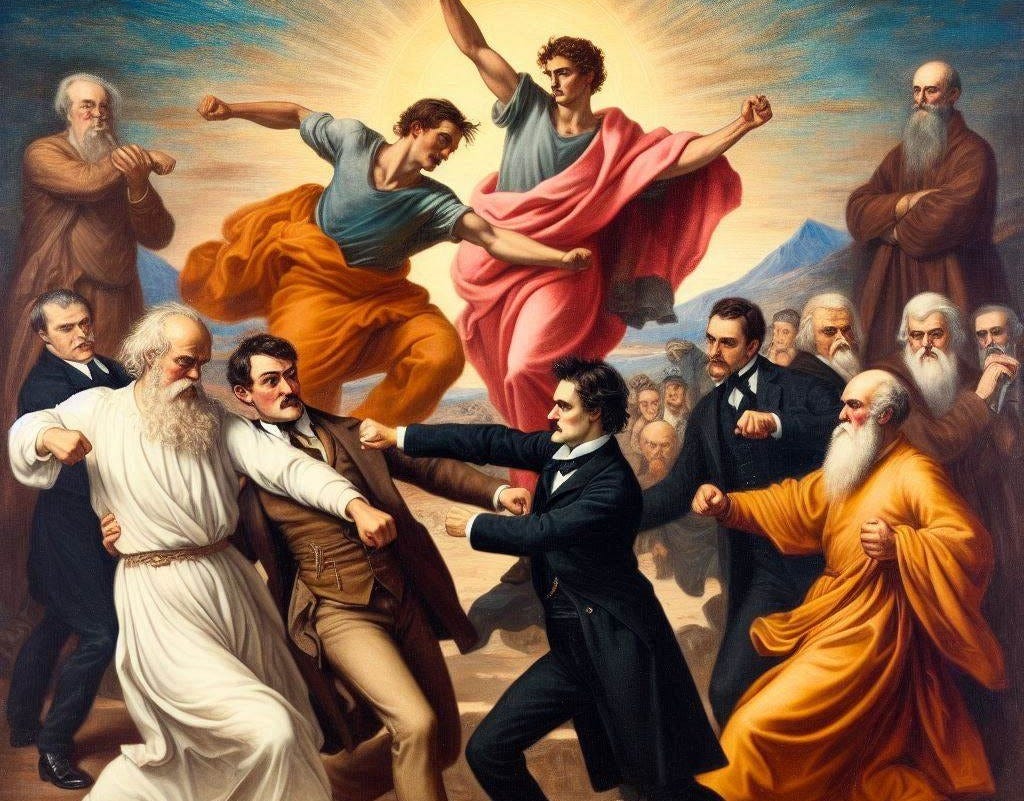
Simply put, there's no world where we can do without any of these. You throw away any two of them and you're left with a huge mess. If virtue doesn't lead to some kind of beauty or health or riches then I don’t want it. The point of all spiritual beauty is that it's a means to physical beauty. And quite frankly I'd rather hang myself than live a life without physical beauty. I want it all, and if I can do without being “rich” — in the monetary sense — it's only because I've got enough to not worry about starving.
As such, there is (to my knowledge) no one-size-fits-all “meaning of life.” There is no overarching plan or purpose that overrules the other plans and purposes. There are the things that you love, the things you love for getting you the things you love, and the things that ruin what you love — which you hate: a life-force in itself, inseparable from the goods.
There are little glances across the table at your lover, good jokes and good talks with good friends, taking home your earnings and spending them on what you want, resting in a warm and comfortable bed, training your body for the struggles to come and knowing you're ready, having your children pounce you in the morning, watching an enemy convert to your team or implode, fighting for a country you love, praying to God for the wisdom to not screw up, kicking back in an orderly household, a hot meal and a cool shower, learning about what mankind does and did to guess what they're going to do next, saying and singing beautiful things, being responsible for a devastating riposte, earning the respect of your bosses and neighbors, watching and listening to and telling great stories, expressing yourself through the creation of words and sounds and goods, sitting with your parents on the lawn in the springtime, laughing at morons, getting buzzed on tequila, impregnating a woman, and making babies laugh.
I refuse to pick any one of these over the others; but if I had to start anywhere I would start with making a baby and making it laugh — and then working my way outward.
Yours,
-J
September 17th, 2017
P.S. This essay — or much of it, anyway — was written before my re-conversion to Christianity, and as such, it’s missing one big point. That is, that every really good thing is from God, and if you really want to enjoy life, not having everything pried from your fingers before you fall apart and croak, you need to know better things are coming, and that the best way to enjoy everything here is to turn an eye skyward and say thank you.
*The feminists screwed the pooch. For all of human existence, every man’s chief struggle was to support the home. Whether he went to work or to war, he fought and died giving everything he had to his wife and his kids. Simply put, there was almost nobody else to give it to.
What feminists decided was to be the means instead of the end. They said, "how can we be free if we’re so dependent on the men?” — a valid question when your husband didn’t value you and you couldn’t escape from him. And when they took one look at the history books they realized they were left out and asked, “can’t we be important too?” It was pride that got them. That and a lack of imagination.
The shortcoming of history is that it can’t show what things are for. You can say, for instance, that you saved people’s rights, or their country, or stopped a famine, or a plague, or some kind of economic collapse. What you can't say is that you saved Joe Plumber's baby — what the world looked like to him every day as he woke up next to the love of his life; what breakfast in peace looked like, how their garden grew and they ate from it; how they fell asleep watching It’s a Wonderful Life after a long day; how the baby sounded singing its first Christmas carol in church, or watching your boy win his first game at school, or the look on his face reading Goodnight Moon.
Women are the "it" we live for. Families are the “it.” Feminists wanted the glory of supporting all this, of being the means to it; and in the end what they did was to throw it all away.
Those who call themselves wise-men divide life between “important” things and “unimportant” things; but the whole point of important things is to make way for unimportant things. We celebrate soldiering, farming, construction, law; but a life comprised entirely of any one of these would have been a waste. They exist for candlelit dinners and horsing around and playing Scrabble. We only go to war to see kids play.
**Many countries, from Rome to Sparta to the USA, have some story about a mother losing her four boys to war — and instead of breaking down, being happy about it.
This is the weight we throw into politics and war. Without patriotism we lose the home, so we throw away the home and say families are good because they're patriots. And this is the riddle of life. We can never have something worth having unless somebody’s willing to throw everything away for it. A good life is only possible when enough people are good enough to forego it.
Falls short. I would rather read your Christian version.
Welcome to the fight.